

At 3:00 a.m. Eastern Time on Saturday, May 2, 2026, Spirit Airlines Flight 2519 touched down in Dallas–Fort Worth from Detroit. It was a routine arrival on a normal-looking yellow Airbus A320 — and it was the last commercial flight Spirit Airlines would ever operate. Within hours, the carrier’s website went dark, customer service lines closed, and roughly 17,000 direct and indirect employees learned by push notification that the airline that had paid their mortgages was, effective immediately, gone.
For most travelers, the story ended there: stranded itineraries, scrambling rebookings, and a quiet sense that the cheapest fares in the sky had just gotten less cheap. For those of us who underwrite, operate, and advise in this industry, the Spirit shutdown is something else entirely — the cleanest case study in years of how a viable business model can become a balance-sheet trap, and how quickly a single exogenous shock can convert a turnaround plan into a wind-down budget.
This is not a postmortem on a bad airline. Spirit was, for the better part of two decades, a meaningfully profitable one. This is a postmortem on the structural fragility that develops when a business optimized for one cost environment is forced to operate in a different one — and when its capital structure, its labor agreements, and its regulatory posture are all calibrated to the wrong scenario.
WHAT ACTUALLY HAPPENED
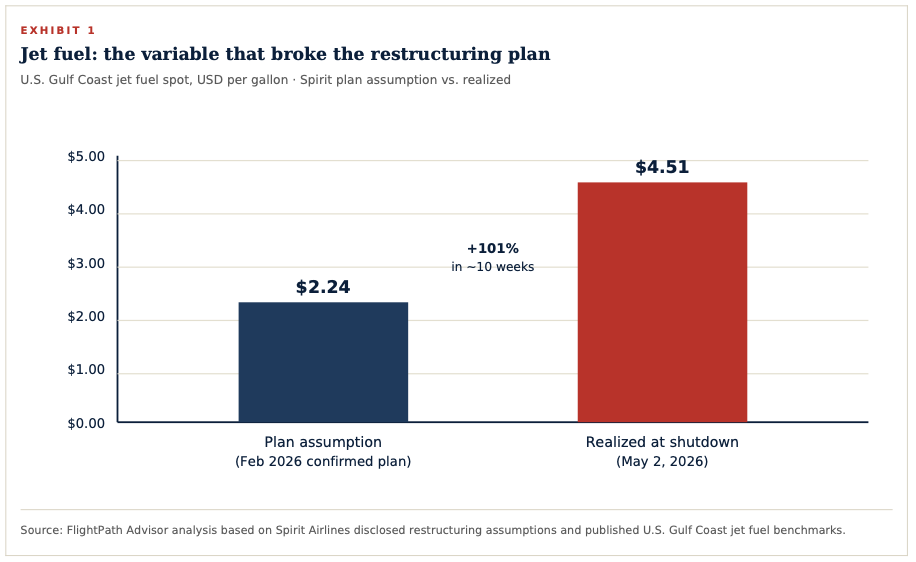
The proximate cause of Spirit’s grounding was simple arithmetic. The airline emerged from its second Chapter 11 filing in February 2026 with a restructuring plan that assumed jet fuel would average roughly $2.24 per gallon in 2026 and $2.14 in 2027. Three days after that plan was confirmed, hostilities between the United States, Israel, and Iran disrupted approximately 20% of global oil supply, and jet fuel spot prices doubled. By the morning of the shutdown, jet fuel was trading near $4.51 per gallon.
That single variable — the price of the second-largest line item on any airline’s income statement — moved against Spirit by more than 100% in roughly ten weeks. For a carrier whose entire competitive thesis is cost leadership, and whose post-bankruptcy liquidity cushion was calibrated for the prior fuel curve, there was no operational lever large enough to absorb it.
But blaming the war, or the fuel curve, mistakes the trigger for the cause. The cause was a decade of strategic decisions that produced a carrier with no margin for error.
HOW IT HAPPENED: A SLOW EROSION, THEN A SUDDEN ENDING
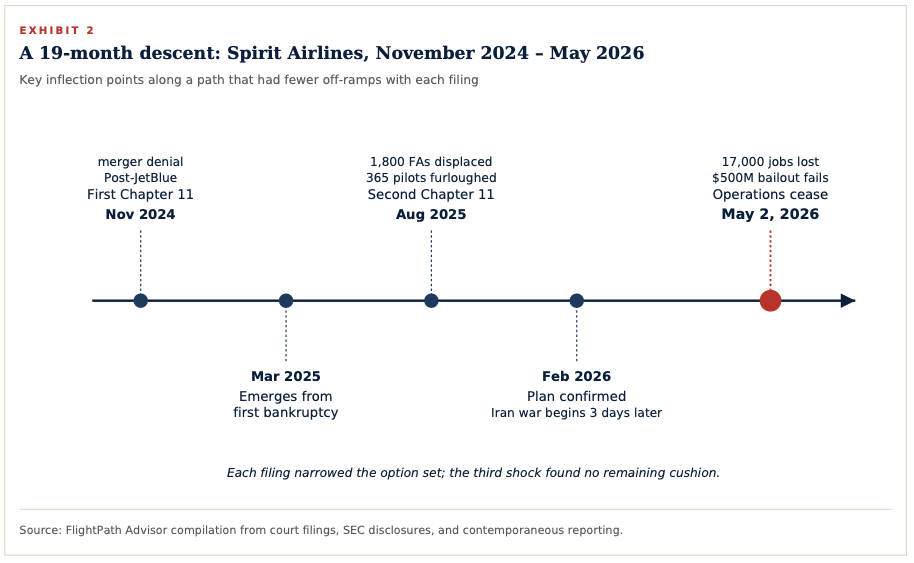
Spirit did not fail in May 2026. Spirit failed slowly, beginning around 2019, and then suddenly. The slow phase has four chapters that any serious operator or lender should be able to recite from memory.
1. THE MODEL LOST ITS MOAT
Spirit pioneered the ultra-low-cost carrier (ULCC) model in the United States: rock-bottom base fares, à la carte fees for everything from seat selection to carry-on bags, and ruthless cost discipline at every input. For a long time, that approach generated industry-leading margins. The problem is that the model only works if you have a real and durable unit-cost advantage over the legacy carriers. By the early 2020s, that advantage had eroded — the major airlines launched their own “basic economy” products that priced competitively against Spirit on the routes that mattered, and Spirit’s own unit costs rose with new pilot and flight-attendant contracts, engine reliability issues, and aircraft delivery delays. Once the cost gap narrowed, the only thing Spirit was offering that the legacies were not was a worse customer experience.
2. THE EXITS GOT BLOCKED
Faced with structural cost compression, Spirit pursued the rational consolidation move: a sale. JetBlue’s $3.8 billion acquisition agreement, struck in 2022 and pursued through 2023, was the airline’s most credible path to a sustainable cost base. When the Department of Justice prevailed in court and the merger was blocked in January 2024, Spirit’s board lost the one option that solved the strategic problem rather than merely deferring it. A subsequent renewed Frontier proposal at a steeply discounted valuation was rejected by Spirit’s own creditors. From that point forward, every available path was a restructuring path.
3. THE BALANCE SHEET RAN OUT OF SLACK
Spirit’s first Chapter 11 filing in November 2024 was, in retrospect, the right call too late. The plan that emerged in March 2025 reduced debt and trimmed the fleet, but it did not solve the underlying revenue problem: a brand reputation that, as one analyst at Raymond James put it, was carrying a “historical brand deficit” that no amount of premium-seat retrofitting could overcome in the timeframe the capital structure required. The carrier was back in court by August 2025. Two Chapter 11 filings in nine months is not a restructuring — it is a market signaling that the franchise is impaired.
4. THE BAILOUT BROKE ON THE ROCKS OF EQUITY
The final attempted save was a $500 million liquidity infusion from the Trump administration in exchange for what was reported to be up to a 90% government equity stake. That deal failed not because Washington walked away, but because Spirit’s bondholders — led by Citadel and Ares Management — would not accept the level of dilution it implied. When the senior creditors prefer liquidation over rescue, the rescue is over. The airline shut down within 72 hours.
“When the senior creditors prefer liquidation over rescue, the rescue is over.”
WHAT IT MEANS FOR U.S. AVIATION
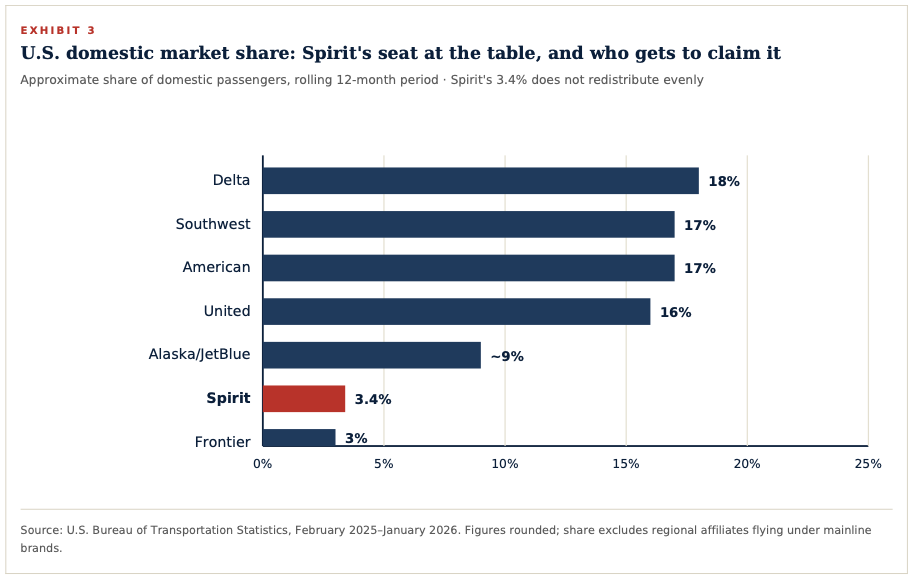
The temptation, particularly among industry commentators with three-day deadlines, is to treat Spirit’s exit as a discrete event affecting roughly 3% of domestic seat capacity and call the story done. That underweights three second-order effects that will compound through the rest of 2026 and into 2027.
FARES WILL RISE — UNEVENLY, AND MORE THAN MOST PEOPLE EXPECT
Spirit’s enduring legacy was not the seats it sold; it was the seats it forced its competitors to sell cheaply. Academic and regulatory research has consistently shown a measurable “Spirit effect” on route-level pricing: when an ULCC enters a route, average fares fall for all carriers; when it exits, they rebound. Removing roughly 2% of domestic summer flying out of a system that is already constrained by air-traffic controller shortages, aircraft delivery delays, and engine-availability issues is not symmetric across the country. Travelers flying out of Fort Lauderdale, where Spirit held roughly a 27% local market share, will feel the change in their fall booking. Travelers flying transcontinental from primary hubs will feel less.
THE REMAINING ULCCs ARE NOT SAFE YET
Spirit’s collapse should not be read as the elimination of risk from the budget-carrier segment. It should be read as evidence of how thin the cushion is. Frontier disclosed a $149 million operating loss for 2025. The Association of Value Airlines, a trade group whose members include Frontier, Allegiant, Sun Country, and others, has reportedly approached the Trump administration for approximately $2.5 billion in federal aid. The same fuel shock that broke Spirit is pressuring every ULCC balance sheet in the country, and at least one is likely to face a financing event before year-end. Lenders to those carriers — and pilots considering offers from them — should price that risk explicitly rather than assuming the segment has bottomed.
CONSOLIDATION, NOT COMPETITION, IS THE TREND
The Spirit estate is now being broken up in bankruptcy court rather than sold as a going concern. Frontier, JetBlue, Breeze Airways, and Southwest are expected to bid for individual pieces — gates at Fort Lauderdale, slots at LaGuardia and Reagan National, leased A320s, and crew bases. This is consolidation by liquidation rather than consolidation by merger, and it produces the same end state the DOJ blocked in 2024, but with worse outcomes for displaced employees, ticket holders, and unsecured creditors. The strategic lesson for regulators is uncomfortable: the merger that was blocked on competition grounds has been replaced by a disorderly outcome that delivers less competition, not more.
WHAT HAPPENS TO THE PEOPLE
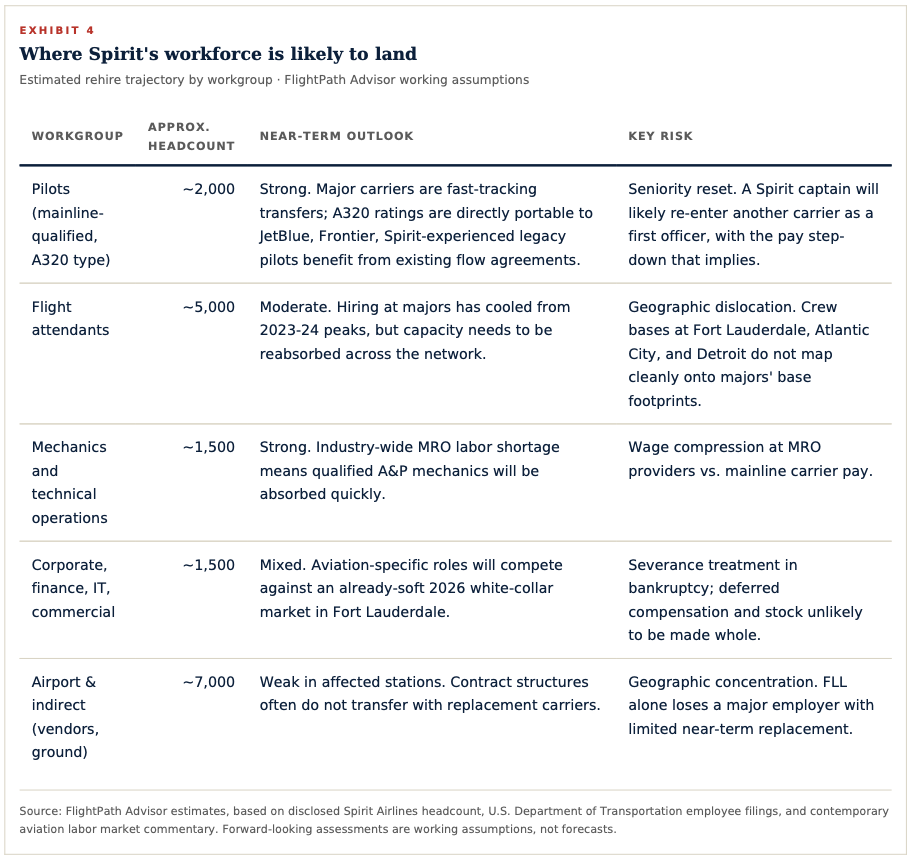
Of the roughly 17,000 direct and indirect employees affected, the trajectory varies sharply by craft and seniority. The aviation labor market in mid-2026 is markedly different from the one that absorbed previous airline failures.
WORKFORCE SUMMARY BY GROUP:
• Pilots (A320-qualified, ~2,000): STRONG outlook. Major carriers are fast-tracking transfers; A320 ratings are directly portable to JetBlue, Frontier, and legacy carriers. KEY RISK: Seniority reset — a Spirit captain will likely re-enter another carrier as a first officer, with the pay step-down that implies.
• Flight attendants (~5,000): MODERATE outlook. Hiring at majors has cooled from 2023–24 peaks. KEY RISK: Geographic dislocation — crew bases at Fort Lauderdale, Atlantic City, and Detroit do not map cleanly onto majors’ footprints.
• Mechanics & technical operations (~1,500): STRONG outlook. Industry-wide MRO labor shortage means qualified A&P mechanics will be absorbed quickly. KEY RISK: Wage compression at MRO providers vs. mainline carrier pay.
• Corporate / finance / IT / commercial (~1,500): MIXED outlook. Aviation-specific roles competing in an already-soft 2026 white-collar market in Fort Lauderdale. KEY RISK: Severance treatment in bankruptcy; deferred compensation unlikely to be made whole.
• Airport & indirect / vendors / ground (~7,000): WEAK near-term in affected stations. Contract structures often do not transfer with replacement carriers. KEY RISK: Geographic concentration — FLL alone loses a major employer with limited near-term replacement.
For pilots specifically, the practical playbook is well-established but emotionally brutal: keep all credentials current, accept that seniority resets are the cost of moving carriers, and pursue offers from multiple operators in parallel rather than sequentially. The U.S. Department of Transportation has confirmed that other carriers are extending travel-pass benefits and jump-seat privileges to displaced Spirit crews, which is a meaningful logistical support but not a financial one. For flight attendants and ground staff, the calculus is harder, and the geographic dislocation of moving from Fort Lauderdale to wherever a hiring base is open creates real household-level cost that severance is unlikely to cover.
WHAT THIS MEANS FOR OPERATORS, LENDERS, AND CAPITAL PARTNERS
Spirit’s collapse will be cited in business school case studies for the next decade, but its operational lessons are immediate and concrete. Three observations for anyone with capital, exposure, or career risk in the U.S. aviation sector:
STRESS-TEST YOUR FUEL ASSUMPTION, THEN TEST IT AGAIN
Spirit’s confirmed restructuring plan used a $2.24 per gallon fuel assumption. That number was not negligently chosen; it sat within a defensible band of forward-curve forecasts at the time. The failure was not in the central estimate — it was in the absence of a credible Plan B if the central estimate proved wrong. Any restructuring, recapitalization, or operational forecast in this industry should now be tested against a fuel scenario at least 50% above forward-curve mid, with explicit identification of what cost or capacity levers are pulled if that scenario materializes. If those levers do not exist, the plan is not a plan — it is a hope.
REPUTATION IS AN ASSET THAT DEPRECIATES FASTER THAN AIRCRAFT
Spirit’s brand was a load-bearing problem. The post-2024 attempt to reposition the carrier toward a “premium economy” product was strategically correct and tactically too late. Brand equity in the airline industry takes a decade to build and roughly eighteen months to lose. Carriers attempting reposition strategies after a financial event should assume the brand penalty is larger and more persistent than their internal modeling suggests.
CAPITAL STRUCTURE IS DESTINY IN RESTRUCTURING
The final negotiation that doomed Spirit was not with Washington — it was between Spirit’s own bondholders and the proposed terms of the federal infusion. Citadel and Ares had legitimate fiduciary reasons to reject a dilution that would have wiped out their recovery on the senior debt. The lesson for any private operator considering a capital event in distress is that the time to align senior creditors with management’s preferred path is before the next shock, not during it. Every restructuring is a coalition-management exercise as much as a financial one.
“Brand equity in the airline industry takes a decade to build and roughly eighteen months to lose.”
Spirit Airlines will be remembered as the first major U.S. passenger carrier to fully liquidate in roughly twenty-five years. Its assets — 159 in-service and stored Airbus A320s and A321s, gates and slots at more than seventy U.S. airports, and an operating certificate that is now permanently surrendered — will be absorbed by competitors over the next twelve to eighteen months. Fares on Spirit’s busiest routes are already moving. The Fort Lauderdale local economy is absorbing a significant employer loss. Bankruptcy court in White Plains will spend much of 2026 and 2027 working through a wind-down budget that currently sits near $217 million.
But the more important consequence is the precedent. Three things have been demonstrated, in public, that capital markets, regulators, and aviation operators will not unsee: that the ULCC model in its 2010s form is no longer financially viable at scale in the United States; that two Chapter 11 filings within nine months is a terminal pattern, not a recoverable one; and that federal bailout authority, even when offered, can be vetoed by private creditors with seniority. Each of those findings will reshape decisions across the industry for years.
For operators who survive this fuel cycle, the prize is real: meaningfully reduced direct competition on hundreds of routes and the opportunity to acquire experienced labor and serviceable aircraft at distressed-asset prices. For those whose own balance sheets resemble Spirit’s circa late 2024, the warning is clearer than it has ever been. The window in which a credible recapitalization, sale, or strategic combination can be executed is shorter than most management teams believe, and the cost of waiting until the second filing is, in the limit, the airline itself.
Leave a Reply